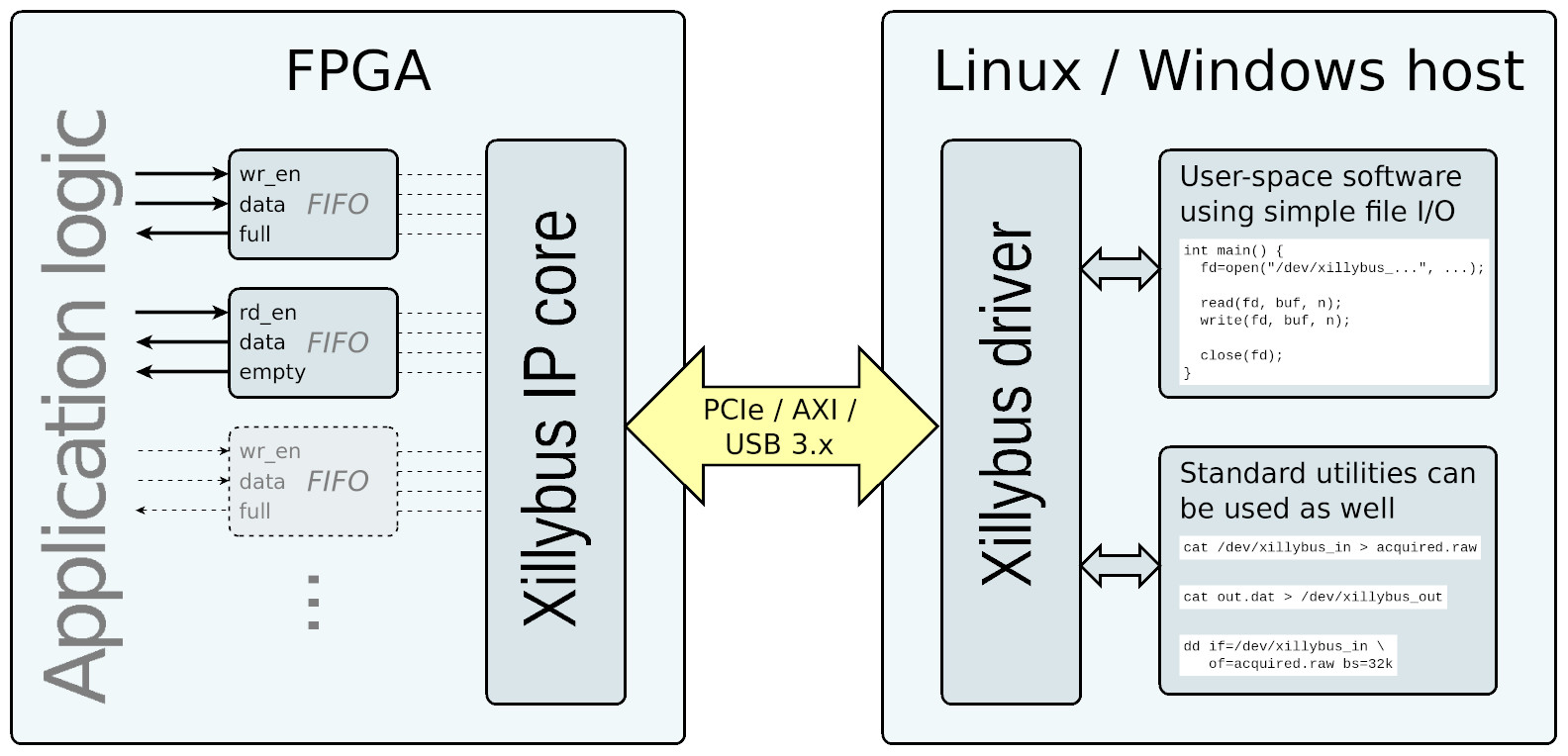
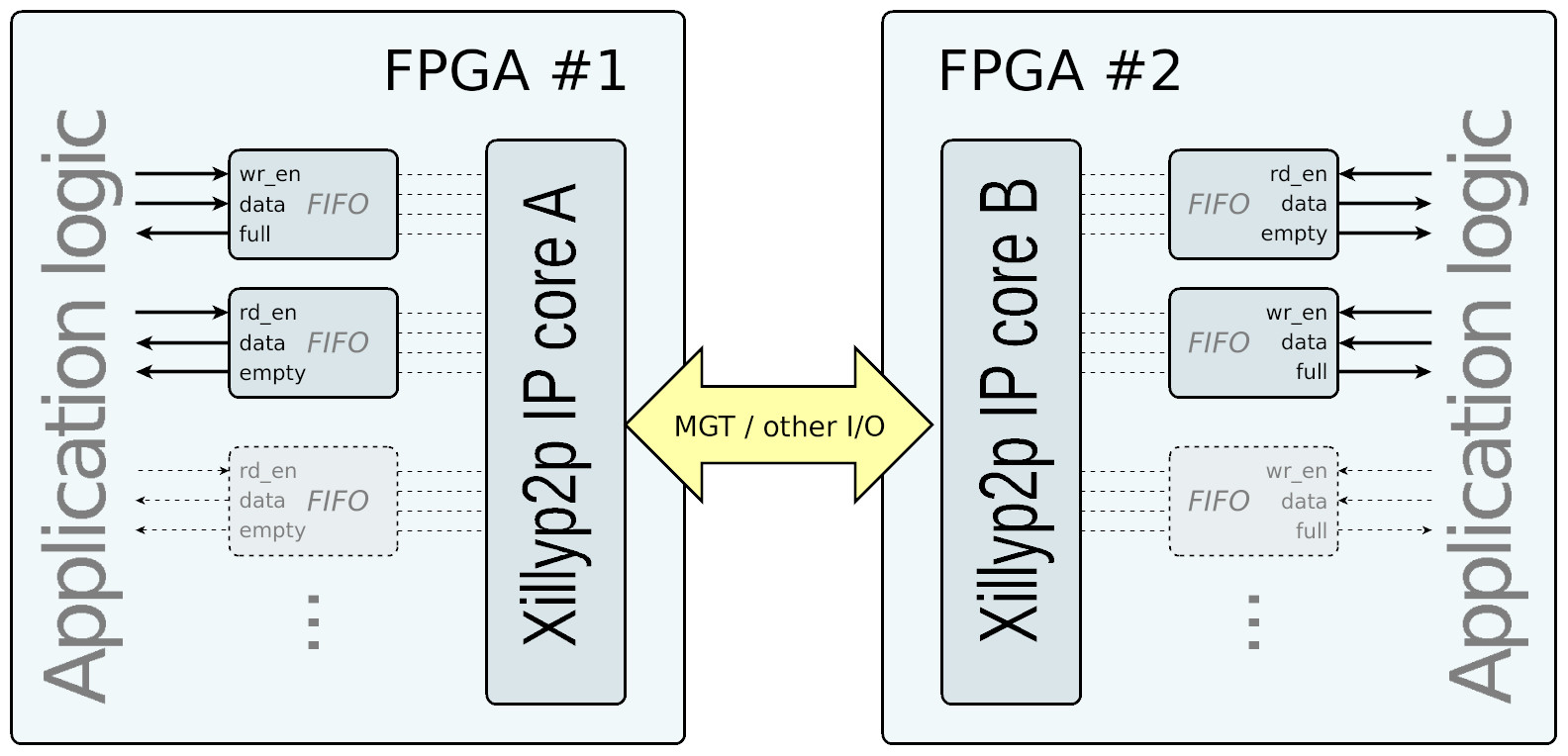
Xillybus and XillyUSBConnecting an FPGA with a Linux / Windows host through a PCIe, AXI or SuperSpeed USB bus. | | Xillyp2pConnecting two FPGAs through a Multi-Gigabit transceiver (MGT) or simpler I/O (serial / parallel wires between two FPGAs). |
Features- Minimal effort for setting up the data exchange link, cutting development risk, cost and schedule dramatically
- An FPGA IP core and a driver for the host create an illusion of a continuous data stream between a FIFO and a file on the host
- No low-level design or driver programming
- FPGA designers interface with the IP core through a standard FIFO or dual-port memory
- Simple API: Application software written in userspace, using simple streaming file I/O
- DMA used exclusively for data transfers, hence minimal load on processor
- Low latency
- A custom IP core automatically generated according to configuration. Up to 160 FIFOs sharing a single PCIe link
- Driver for Linux included in mainstream Linux distributions
- Driver for Windows 7 and later available for download
- Portability: Seamless transition between AMD and Altera FPGAs, Linux and Windows
- Works on any host with PCIe and/or USB 3.x: Common PC computers, PC-on-board (PCI/104-Express) and embedded processors (e.g. NXP's i.MX series, and Nvidia Jetson / Tegra)
| Applications- Data acquisition
- Video capture and playback
- Hardware acceleration
- FPGA control from host
- Easy design of peripherals
- Interface with dedicated hardware
- Logic verification on hardware
- Fast development of dedicated lab equipment
- Debugging
More informationTry it out!
Try Xillybus with your application data from the FPGA to the host and vice versa. It's not just a demo, it works for real. Connect your application data to a standard FIFO, boot the computer or FPGA with either Windows or Linux, and see how easy it is to talk with your FPGA!
Very fast setup: A day or two is the typical lead time from downloading core & drivers to an end-to-end integration between host application and dedicated logic on FPGA. | Features- Comprehensive and complete solution for a point-to-point connection through an MGT or other serial / parallel I/O, cutting development risk, cost and schedule dramatically
- Data rates: 10 Mbit/s to the physical link's limit
- Multiple independent communication channels, per custom configuration.
- Simple and intuitive interface: Each communication channel behaves like a FIFO spanning across the two FPGAs
- Flow control fully implemented by the IP core, based upon respecting the receiving FIFO's "full" port.
- Reliable data handling: Error detection and automatic retransmission
- Optional End-of-Packet port allows dividing data stream into packets
- Simple setup of MGT: Only SERDES functionality required. All synchronization needs and clock frequency compensation are implemented inside the IP core
- Hotpluggable
- 97% bandwidth efficiency (application data rate to physical link's data rate, typical at BER=0). Raw bandwidth is divided among the application channels for low latency and optimal performance
- Data on physical link is randomized with a scrambler, allowing equalizer
- Automatic compensation for negated bit polarity
- Built-in optional bit error injection for testing
- Unidirectional physical link supported (albeit without flow control or automatic retransmission)
| Applications- Connection between several FPGAs on the same board
- Connection between FPGAs through a backplane.
- Data acquisition with a remotely located FPGA
- Data output to a remote facility
- Long-distance data transport using optical fiber
- Electrical isolation (using optical fiber)
- Data link with peripheral equipment through a cable (cameras, displays, sensors, radio transceivers etc.)
- Cost reduction of I/O-intensive applications
More informationTry it out!Try Xillyp2p with your application data. It's not just a demo, it works for real. Xillyp2p is easy to integrate with an MGT or with general-purpose FPGA I/O. Refer to Xillyp2p's main page for a complete design example of setting up a GTX / GTH for an optical fiber connection between two development boards, including the complete setup of the MGT block, instantiation of this block as well as the Xillyp2p IP core and constraints. |